

The 5P Launch Model™: A Proven Framework for Global Hospitality & Lifestyle Brands
Launching a brand is one of the highest-stakes moments in business. It’s when years of strategy, investment, and vision collide with the reality of the market. For hospitality and lifestyle brands, the stakes are even higher. Unlike a SaaS product or industrial service, these brands sell experiences and emotions. Guests are not just buying a stay, a meal, or a product — they’re buying identity, belonging, and status.
And yet, despite the glamour and the big budgets, over 70% of launches fail to meet their objectives (Harvard Business Review). The reasons are consistent across industries: lack of clarity in purpose, weak positioning, overspending on PR without traction, and no plan to sustain momentum post-launch.
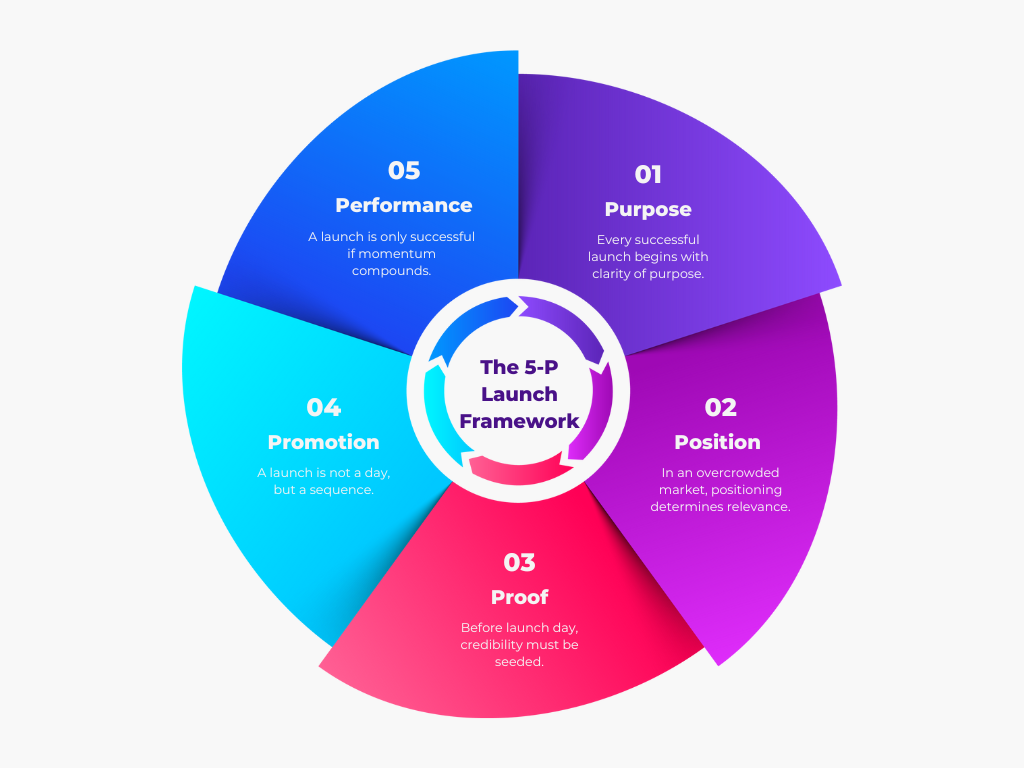
At Launch Party India, we’ve studied global best practices and distilled them into a proprietary framework — the 5P Launch Model™. This model combines consulting discipline with creative execution, ensuring every launch is purpose-led, strategically positioned, credibility-backed, promotion-ready, and performance-driven.
1. Purpose: Define the “Why”
Every great launch begins with purpose. Without it, campaigns feel hollow and customers fail to connect. Purpose isn’t a tagline or a slogan — it’s the fundamental reason the brand exists.
Why Purpose Matters
Customers today, especially millennials and Gen Z, are increasingly motivated by meaning. According to Edelman’s Trust Barometer, 64% of global consumers are belief-driven buyers — they choose brands aligned with their values. For a hospitality brand, this could mean a purpose rooted in sustainability or cultural authenticity. For a lifestyle brand, it could be empowerment, inclusivity, or design-led innovation.
Global Examples
- Tesla didn’t say “we make electric cars.” Its purpose was framed as “accelerating the world’s transition to sustainable energy.” That mission pulled customers, investors, and employees into a bigger story.
- Patagonia goes further: “We’re in business to save our home planet.” This purpose guides product design, marketing campaigns, and even corporate activism. The result? A cult-like following and long-term resilience.
The Risk of Ignoring Purpose
Launches without purpose become gimmicky. Think of many failed celebrity-backed lifestyle brands that relied on hype but couldn’t articulate why they existed beyond selling products. The lack of authenticity leads to quick drop-offs in engagement.
Checklist for Purpose
- ✅ Is your vision clear and inspiring?
- ✅ Have you codified values that shape guest experiences?
- ✅ Can you state a single guest promise in one line?
- ✅ Is founder intent aligned with a genuine market need?
- ✅ Can every team member repeat the purpose consistently?
👉 At Launch Party India, our Purpose Workshops help founders clarify intent and craft narratives that resonate deeply with audiences.
2. Position: Own Your Place
Once purpose is defined, the next challenge is positioning. In crowded markets, positioning is the only way to cut through. It determines how your brand is perceived relative to competitors and where it plays in the customer’s mental map.
Why Positioning Matters
Without sharp positioning, even innovative brands fade. Competing purely on features or price leads to commoditization. The winners are those that own a unique mental space.
Global Examples
- Airbnb redefined travel by positioning itself as “belong anywhere.” This was not about cheap stays but about belonging and community, allowing it to compete against global hotel giants without playing the same game.
- Apple has consistently positioned itself as the brand of design-led innovation. Even when competitors launched feature-heavy devices, Apple’s positioning allowed it to command premium pricing and unmatched loyalty.
The Risk of Weak Positioning
Brands without clear positioning get lost in the “sea of sameness.” A new café that markets itself as “premium coffee” without a unique angle will be forgotten quickly in a market dominated by Starbucks or Blue Bottle.
Checklist for Position
- ✅ Have you mapped competitors on price, design, and perception?
- ✅ Can you name 2–3 true differentiators?
- ✅ Is your pricing strategy consistent with your target market?
- ✅ Do you have a primary customer persona?
- ✅ Is your positioning consistently expressed in PR, interiors, menus, and digital touchpoints?
How to Action It: Build a Positioning Map. Place competitors along two axes — for example, affordability vs. exclusivity and casual vs. luxury. Find the white space where your brand can win.
👉 Many lifestyle and hospitality brands engage Launch Party India to reposition effectively before launch, ensuring their story stands out in noisy markets.
3. Proof: Build Early Credibility
No matter how strong your purpose and positioning, customers won’t believe you until they see proof. Proof bridges the trust gap between what you say and what the market believes.
Why Proof Matters
In a world of information overload, skepticism runs high. Nielsen reports that 92% of people trust recommendations from individuals (even strangers) over brands. That means proof assets — testimonials, previews, alliances — are more persuasive than ads.
Global Examples
- Glossier built credibility by engaging its community before launch. By inviting early customers into the product development process, it ensured launch day was validation, not discovery.
- Apple uses product leaks, beta reviews, and early influencer access to build credibility before launch. By the time a new iPhone is revealed, trust is already established.
The Risk of Skipping Proof
Without proof, PR feels hollow. Customers may try once out of curiosity but won’t return. A lifestyle café that launches with influencers but no credible proof of quality will see a rapid drop-off in repeat visits.
Checklist for Proof
- ✅ Do you have testimonials from early adopters or beta testers?
- ✅ Have you shared behind-the-scenes previews to spark anticipation?
- ✅ Is there a compelling founder story?
- ✅ Have you built alliances with trusted partners?
- ✅ Are journalists and influencers given exclusive first looks?
How to Action It: Develop a Credibility Calendar. From months before launch, seed stories, visuals, and reviews strategically.
👉 Our Credibility Playbooks at Launch Party India ensure clients build trust before hype.
4. Promotion: Orchestrate the Launch Campaign
Promotion is often mistaken as “the launch.” In reality, promotion is just one pillar. But when done right, it turns good launches into cultural moments.
Why Promotion Matters
A launch isn’t just one event — it’s a journey of buzz → reveal → sustain. Brands that view promotion as a one-night spectacle burn money without long-term impact.
Global Examples
- Netflix has mastered phased promotion: pre-launch teasers, influencer collaborations, launch-day events, and post-launch social storytelling. This ensures every release becomes a global conversation.
- Supreme thrives on hype by creating scarcity. Its “drop culture” makes launches anticipated rituals, with lines forming outside stores worldwide.
The Risk of Mismanaging Promotion
Overspending on one channel (say PR) without balance leads to wasted budgets. Worse, if the experience doesn’t match the hype, backlash follows.
Checklist for Promotion
- ✅ Is there a pre-launch buzz plan with teasers and collaborations?
- ✅ Is launch day designed as a memorable spectacle?
- ✅ Are PR, influencers, and partnerships balanced, not bloated?
- ✅ Is storytelling consistent across channels?
- ✅ Do you have a 90-day post-launch content pipeline?
How to Action It: Build a 3-Phase Campaign Framework:
- Pre-launch buzz (controlled leaks, teasers).
- Launch-day event (spectacle amplified digitally).
- Post-launch engagement (sustained storytelling).
👉 At Launch Party India, we design orchestrated campaigns that maximize ROI while minimizing burn.
5. Performance: Sustain Through Measurement
Finally, the most overlooked pillar: performance. A launch is not the finish line; it’s the starting gun. Without measurement and refinement, even strong launches fizzle.
Why Performance Matters
McKinsey research shows that brands that track post-launch performance with discipline outperform peers by 60% in long-term growth. Metrics create feedback loops that sustain momentum.
Global Examples
- Nike doesn’t just launch products — it measures cultural impact, digital engagement, and loyalty sign-ups. Its “Just Do It” campaigns live far beyond ads because performance is tracked and optimized.
- Starbucks tracks more than opening sales. Metrics like app downloads, repeat visits, and loyalty engagement allow it to refine offers and sustain long-term relationships.
The Risk of Ignoring Performance
Brands that celebrate opening day without measuring what happens after quickly lose relevance. Re-launches become necessary — at much higher costs.
Checklist for Performance
- ✅ Have you defined KPIs (awareness, bookings, repeat customers)?
- ✅ Are you tracking digital sentiment (reviews, social chatter)?
- ✅ Do you monitor repeat usage as closely as first-time adoption?
- ✅ Is there a feedback loop into product/service improvements?
- ✅ Do you have a 12-month engagement roadmap?
How to Action It: Create a Launch Dashboard. Measure KPIs weekly for the first 90 days, monthly for the first year.
👉 Launch Party India builds Performance Dashboards to ensure launches evolve into sustainable growth engines.
Conclusion: From Launch to Legacy
The 5P Launch Model™ is not just a checklist — it’s a system. By aligning Purpose, Position, Proof, Promotion, and Performance, brands launch not just with impact, but with momentum that compounds over time.
In today’s hyper-competitive market, the difference between failure and legacy is not how much noise you make, but how disciplined your launch system is.
👉 If you’re preparing for a high-stakes hospitality or lifestyle launch, partner with Launch Party India. We specialize in turning launches into long-term growth engines using our proprietary 5P Launch Model™.
Because the brands that win are not the loudest. They’re the smartest.
The 5P Launch Model™: A Proven Framework for Global Hospitality & Lifestyle Brands
Launching a brand is one of the highest-stakes moments in business. It’s when years of strategy, investment, and vision collide with the reality of the market. For hospitality and lifestyle brands, the stakes are even higher. Unlike a SaaS product or industrial service, these brands sell experiences and emotions. Guests are not just buying a stay, a meal, or a product — they’re buying identity, belonging, and status.
And yet, despite the glamour and the big budgets, over 70% of launches fail to meet their objectives (Harvard Business Review). The reasons are consistent across industries: lack of clarity in purpose, weak positioning, overspending on PR without traction, and no plan to sustain momentum post-launch.
At Launch Party India, we’ve studied global best practices and distilled them into a proprietary framework — the 5P Launch Model™. This model combines consulting discipline with creative execution, ensuring every launch is purpose-led, strategically positioned, credibility-backed, promotion-ready, and performance-driven.
1. Purpose: Define the “Why”
Every great launch begins with purpose. Without it, campaigns feel hollow and customers fail to connect. Purpose isn’t a tagline or a slogan — it’s the fundamental reason the brand exists.
Why Purpose Matters
Customers today, especially millennials and Gen Z, are increasingly motivated by meaning. According to Edelman’s Trust Barometer, 64% of global consumers are belief-driven buyers — they choose brands aligned with their values. For a hospitality brand, this could mean a purpose rooted in sustainability or cultural authenticity. For a lifestyle brand, it could be empowerment, inclusivity, or design-led innovation.
Global Examples
-
Tesla didn’t say “we make electric cars.” Its purpose was framed as “accelerating the world’s transition to sustainable energy.” That mission pulled customers, investors, and employees into a bigger story.
-
Patagonia goes further: “We’re in business to save our home planet.” This purpose guides product design, marketing campaigns, and even corporate activism. The result? A cult-like following and long-term resilience.
The Risk of Ignoring Purpose
Launches without purpose become gimmicky. Think of many failed celebrity-backed lifestyle brands that relied on hype but couldn’t articulate why they existed beyond selling products. The lack of authenticity leads to quick drop-offs in engagement.
Checklist for Purpose
-
✅ Is your vision clear and inspiring?
-
✅ Have you codified values that shape guest experiences?
-
✅ Can you state a single guest promise in one line?
-
✅ Is founder intent aligned with a genuine market need?
-
✅ Can every team member repeat the purpose consistently?
👉 At Launch Party India, our Purpose Workshops help founders clarify intent and craft narratives that resonate deeply with audiences.
2. Position: Own Your Place
Once purpose is defined, the next challenge is positioning. In crowded markets, positioning is the only way to cut through. It determines how your brand is perceived relative to competitors and where it plays in the customer’s mental map.
Why Positioning Matters
Without sharp positioning, even innovative brands fade. Competing purely on features or price leads to commoditization. The winners are those that own a unique mental space.
Global Examples
-
Airbnb redefined travel by positioning itself as “belong anywhere.” This was not about cheap stays but about belonging and community, allowing it to compete against global hotel giants without playing the same game.
-
Apple has consistently positioned itself as the brand of design-led innovation. Even when competitors launched feature-heavy devices, Apple’s positioning allowed it to command premium pricing and unmatched loyalty.
The Risk of Weak Positioning
Brands without clear positioning get lost in the “sea of sameness.” A new café that markets itself as “premium coffee” without a unique angle will be forgotten quickly in a market dominated by Starbucks or Blue Bottle.
Checklist for Position
-
✅ Have you mapped competitors on price, design, and perception?
-
✅ Can you name 2–3 true differentiators?
-
✅ Is your pricing strategy consistent with your target market?
-
✅ Do you have a primary customer persona?
-
✅ Is your positioning consistently expressed in PR, interiors, menus, and digital touchpoints?
How to Action It: Build a Positioning Map. Place competitors along two axes — for example, affordability vs. exclusivity and casual vs. luxury. Find the white space where your brand can win.
👉 Many lifestyle and hospitality brands engage Launch Party India to reposition effectively before launch, ensuring their story stands out in noisy markets.
3. Proof: Build Early Credibility
No matter how strong your purpose and positioning, customers won’t believe you until they see proof. Proof bridges the trust gap between what you say and what the market believes.
Why Proof Matters
In a world of information overload, skepticism runs high. Nielsen reports that 92% of people trust recommendations from individuals (even strangers) over brands. That means proof assets — testimonials, previews, alliances — are more persuasive than ads.
Global Examples
-
Glossier built credibility by engaging its community before launch. By inviting early customers into the product development process, it ensured launch day was validation, not discovery.
-
Apple uses product leaks, beta reviews, and early influencer access to build credibility before launch. By the time a new iPhone is revealed, trust is already established.
The Risk of Skipping Proof
Without proof, PR feels hollow. Customers may try once out of curiosity but won’t return. A lifestyle café that launches with influencers but no credible proof of quality will see a rapid drop-off in repeat visits.
Checklist for Proof
-
✅ Do you have testimonials from early adopters or beta testers?
-
✅ Have you shared behind-the-scenes previews to spark anticipation?
-
✅ Is there a compelling founder story?
-
✅ Have you built alliances with trusted partners?
-
✅ Are journalists and influencers given exclusive first looks?
How to Action It: Develop a Credibility Calendar. From months before launch, seed stories, visuals, and reviews strategically.
👉 Our Credibility Playbooks at Launch Party India ensure clients build trust before hype.
4. Promotion: Orchestrate the Launch Campaign
Promotion is often mistaken as “the launch.” In reality, promotion is just one pillar. But when done right, it turns good launches into cultural moments.
Why Promotion Matters
A launch isn’t just one event — it’s a journey of buzz → reveal → sustain. Brands that view promotion as a one-night spectacle burn money without long-term impact.
Global Examples
-
Netflix has mastered phased promotion: pre-launch teasers, influencer collaborations, launch-day events, and post-launch social storytelling. This ensures every release becomes a global conversation.
-
Supreme thrives on hype by creating scarcity. Its “drop culture” makes launches anticipated rituals, with lines forming outside stores worldwide.
The Risk of Mismanaging Promotion
Overspending on one channel (say PR) without balance leads to wasted budgets. Worse, if the experience doesn’t match the hype, backlash follows.
Checklist for Promotion
-
✅ Is there a pre-launch buzz plan with teasers and collaborations?
-
✅ Is launch day designed as a memorable spectacle?
-
✅ Are PR, influencers, and partnerships balanced, not bloated?
-
✅ Is storytelling consistent across channels?
-
✅ Do you have a 90-day post-launch content pipeline?
How to Action It: Build a 3-Phase Campaign Framework:
-
Pre-launch buzz (controlled leaks, teasers).
-
Launch-day event (spectacle amplified digitally).
-
Post-launch engagement (sustained storytelling).
👉 At Launch Party India, we design orchestrated campaigns that maximize ROI while minimizing burn.
5. Performance: Sustain Through Measurement
Finally, the most overlooked pillar: performance. A launch is not the finish line; it’s the starting gun. Without measurement and refinement, even strong launches fizzle.
Why Performance Matters
McKinsey research shows that brands that track post-launch performance with discipline outperform peers by 60% in long-term growth. Metrics create feedback loops that sustain momentum.
Global Examples
-
Nike doesn’t just launch products — it measures cultural impact, digital engagement, and loyalty sign-ups. Its “Just Do It” campaigns live far beyond ads because performance is tracked and optimized.
-
Starbucks tracks more than opening sales. Metrics like app downloads, repeat visits, and loyalty engagement allow it to refine offers and sustain long-term relationships.
The Risk of Ignoring Performance
Brands that celebrate opening day without measuring what happens after quickly lose relevance. Re-launches become necessary — at much higher costs.
Checklist for Performance
-
✅ Have you defined KPIs (awareness, bookings, repeat customers)?
-
✅ Are you tracking digital sentiment (reviews, social chatter)?
-
✅ Do you monitor repeat usage as closely as first-time adoption?
-
✅ Is there a feedback loop into product/service improvements?
-
✅ Do you have a 12-month engagement roadmap?
How to Action It: Create a Launch Dashboard. Measure KPIs weekly for the first 90 days, monthly for the first year.
👉 Launch Party India builds Performance Dashboards to ensure launches evolve into sustainable growth engines.
Conclusion: From Launch to Legacy
The 5P Launch Model™ is not just a checklist — it’s a system. By aligning Purpose, Position, Proof, Promotion, and Performance, brands launch not just with impact, but with momentum that compounds over time.
In today’s hyper-competitive market, the difference between failure and legacy is not how much noise you make, but how disciplined your launch system is.
👉 If you’re preparing for a high-stakes hospitality or lifestyle launch, partner with Launch Party India. We specialize in turning launches into long-term growth engines using our proprietary 5P Launch Model™.
Because the brands that win are not the loudest. They’re the smartest.

Leave a Reply