

Brand Launch Strategy: How to Avoid Costly Mistakes and Build Long-Term Growth
Launching a brand is one of the most defining moments in business. It is when vision meets market reality, and when customer perceptions are shaped for years to come. Done well, a launch generates momentum, builds credibility, and unlocks exponential growth. Done poorly, it leaves even strong products struggling for relevance, and forces companies to spend far more later just to recover.
In India alone, thousands of new products and services are introduced every year. Yet studies show that over 70% of launches fail to achieve their growth targets. Why? Because many leaders treat launches as events rather than systems. They overemphasize the “big day” while underestimating the storytelling, sequencing, and post-launch discipline that drive long-term success.
At Launch Party India, we’ve seen firsthand that three mistakes repeat across industries: weak storytelling (narrative debt), overspending on PR (PR burn rate), and ignoring post-launch momentum (the momentum gap). Each mistake compounds costs over time — draining budgets, eroding trust, and slowing growth.
This article unpacks these mistakes, introduces proven frameworks to address them, and provides a strategic playbook for brand leaders, CMOs, and startup founders seeking to launch with confidence.
Why Most Brand Launches Fail
A brand launch strategy is not just about awareness — it’s about positioning, traction, and sustainable growth. Yet most organizations fall into predictable traps.
- Over-indexing on PR without securing customer proof points.
- Confusing marketing with storytelling, leading to weak differentiation.
- Treating launch as a finish line, with no system for post-launch growth.
The result? A spike in attention that fizzles quickly, followed by expensive re-acquisition campaigns to regain lost ground.
To understand why, it helps to view launch through a systemic lens. We call this the Launch Equation:
Narrative × Sequencing × Momentum = Market Traction
If any one of these is weak, the equation collapses. Let’s explore each dimension.
Narrative Debt: The Cost of Weak Storytelling
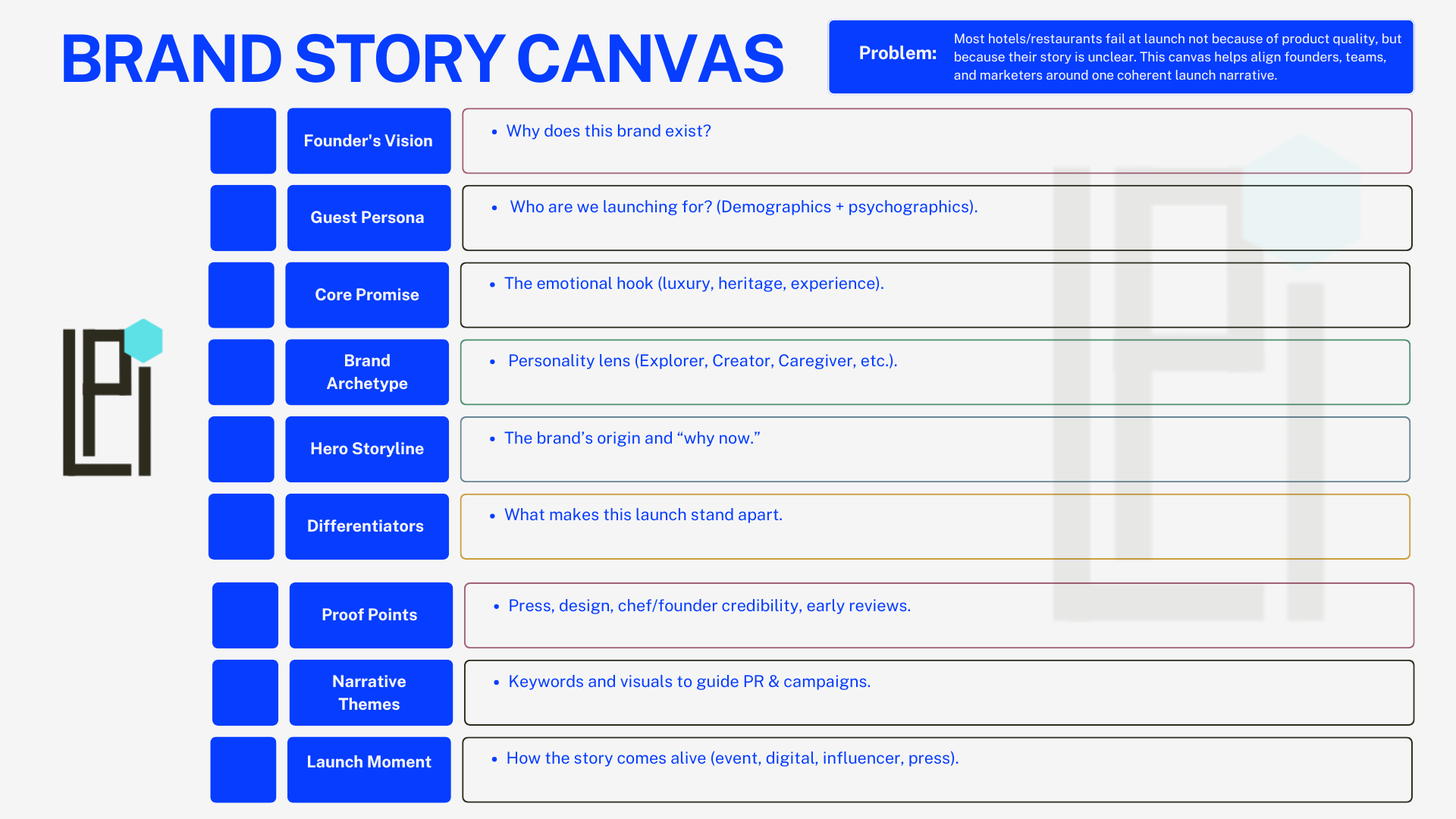
The mistake: Many brands go to market with features, slogans, or disjointed campaigns — but no coherent narrative that explains why they exist, who they serve, and how they are different.
This creates narrative debt — a gap between what the company believes and what the market understands. It forces teams to spend more on marketing to compensate for the lack of clarity, while competitors with stronger stories capture mindshare faster.
The consequence:
- Customers fail to recall the brand or confuse it with others.
- Media coverage feels transactional, not meaningful.
- Early adopters hesitate to advocate because the brand’s “why” is unclear.
The Framework: The 3-Layer Narrative
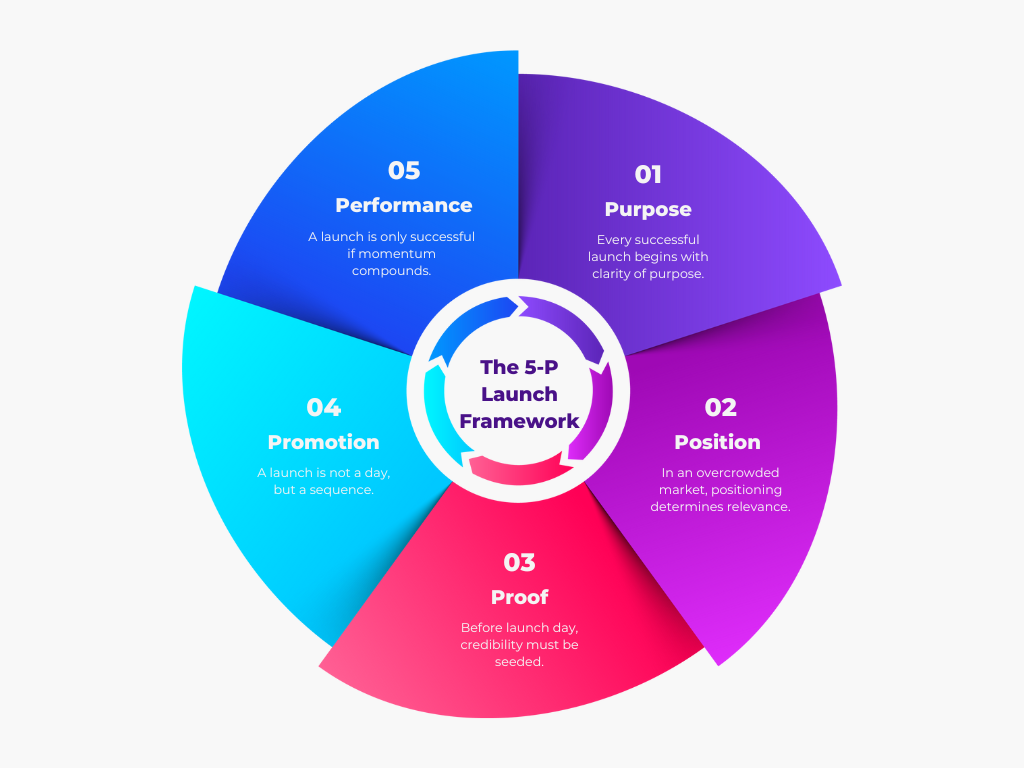
A strong brand launch narrative rests on three layers:
- Purpose — Why your brand exists. What change are you driving?
- Position — Where you play and how you win. What unique problem do you solve?
- Proof — Evidence that your claims hold. Testimonials, pilots, data.
For example, Tesla’s launch narrative was never “an electric car.” It was: accelerating the world’s transition to sustainable energy (purpose), positioned as a premium alternative to combustion vehicles (position), validated through early adopters and performance benchmarks (proof).
Brand Storytelling Strategy
If you’re searching for “how to build brand narrative for a launch” or “brand storytelling strategy India,” the answer lies not in advertising but in alignment. A consistent narrative across PR, digital, sales decks, and customer onboarding compounds credibility.
👉 At Launch Party India, we specialize in narrative workshops that help founders and marketing teams craft differentiated positioning before going live.
PR Burn Rate: Overspending Without Traction
The mistake: In the excitement of launch, companies overspend on PR campaigns, influencer marketing, or lavish events without having first established customer traction. This creates a PR burn rate — wasted spend that generates vanity metrics but no sustainable growth.
The consequence:
- Short-lived spikes in attention without retention.
- Mismatch between hype and customer experience, leading to backlash.
- Inflated customer acquisition costs (CAC) over time.
Why This Happens
Leaders often equate visibility with success. But PR is an amplifier, not the engine. Without substance — customer proof, product validation, community buzz — amplification falls flat.
The Framework: The Staged PR Model
To avoid PR burn rate, sequence your spend through stages:
- Validation StageFocus on customer pilots, testimonials, and beta buzz.
- Build “evidence assets” that journalists and influencers can reference.
- Amplification StageLeverage earned media, thought-leadership articles, and category positioning.
- Begin scaling PR once there’s proof to amplify.
- Acceleration StageOnly after traction, invest in paid media, partnerships, and large-scale campaigns.
- Align spend with clear metrics (CAC, conversion, LTV).
Product Launch PR Strategy
Searches like “how to scale PR for brand launch India” or “product launch PR strategy” reflect a pain point: founders want buzz but fear waste. The solution is sequencing spend to readiness.
👉 At Launch Party India, our go-to-market playbooks align PR budgets with traction milestones — ensuring you never burn cash before impact.
The Momentum Gap: Ignoring Post-Launch
The mistake: Many brands see launch as the finish line. They pour months of effort into “day one,” but once the campaign ends, momentum stalls. This creates a momentum gap — the failure to sustain awareness, engagement, and customer adoption over time.
The consequence:
- Initial buzz fades within weeks.
- Competitors reclaim attention.
- Re-launch efforts become necessary, at higher cost.
The Framework: Launch-to-Scale Roadmap
To close the momentum gap, leaders must design a 12-month post-launch strategy.
- 0–90 Days: Customer Onboarding + AdvocacyPrioritize customer support and onboarding.
- Collect reviews, testimonials, and case studies.
- 90–180 Days: Content + CommunityPublish product updates, behind-the-scenes insights, and user success stories.
- Activate communities through events, webinars, or local partnerships.
- 180+ Days: Market ExpansionIntroduce category thought-leadership.
- Explore adjacent segments, new geographies, or strategic alliances.
Post-Launch Strategy
High-intent searches like “sustaining brand momentum” or “post-launch marketing strategy in India” are becoming more frequent. This reflects growing awareness that launch is a process, not a moment.
👉 At Launch Party India, we design scale-up roadmaps that extend beyond launch, ensuring energy compounds instead of evaporates.
A Strategic Playbook for High-Stakes Launches
When viewed holistically, the three mistakes — narrative debt, PR burn rate, and the momentum gap — are symptoms of the same issue: lack of a systemic framework for launch.
To overcome this, we recommend the following checklist:
- Narrative Audit: Can your team articulate purpose, position, and proof in one sentence?
- PR Sequencing: Are budgets aligned with traction milestones?
- Momentum Roadmap: Do you have a 6–12 month plan beyond launch week?
- Metrics Discipline: Are you tracking CAC, conversion, and retention at each stage?
- Cross-Functional Alignment: Is your narrative consistent across product, marketing, and sales?
Leaders who embrace this playbook reduce launch costs, accelerate adoption, and create long-term category leadership.
👉 For companies preparing for high-stakes launches, Launch Party India provides consulting frameworks, go-to-market strategies, and post-launch growth systems designed to maximize traction while minimizing waste.
Final Takeaways
A launch is not about being the loudest on day one. It is about orchestrating a system that connects narrative, sequencing, and momentum. Brands that fail to address narrative debt, PR burn rate, and the momentum gap end up paying far more in the long run.
The strategic takeaway is simple: treat launch as a system, not an event.
If you’re a founder, CMO, or business leader preparing to launch in India, the difference between fading fast and compounding growth is whether you adopt a framework-driven brand launch strategy.
👉 At Launch Party India, we partner with ambitious brands to design and execute story-driven, strategy-led, and momentum-sustaining launches. The brands that win are not those who shout the loudest, but those who sequence the smartest.

Leave a Reply